
General
- General
- Solutions
- Products
- Cases
- Technology
- News
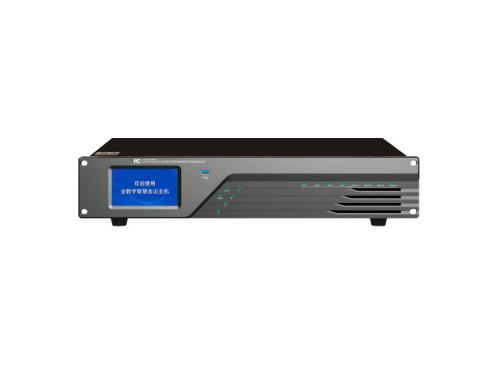
The fully digital conference system is built on a Gigabit network audio transmission architecture. It supports multi-channel concurrent processing, allowing 128 microphones to be turned on simultaneously for stable speech. The system highly integrates audio processing and conference discussion control, offering professional-grade audio capabilities with an ultra-low end-to-end latency of 2–3 milliseconds from microphone pickup to output. Additionally, the system innovatively integrates practical functions such as multi-room management with a single Controller and identity recognition, fully empowering a high-quality and high-efficiency conference sound reinforcement experience.
*Built on a Gigabit network audio transmission architecture, all core components utilize domestic chips. It can connect digital wired microphones, digital wireless microphones, and analog microphones; it supports multi-channel concurrent processing, allowing 128 microphones to be turned on simultaneously for stable speech.
*Ultra-large system capacity, supporting the simultaneous connection, management, and use of 65,535 wired conference units and 300 wireless conference units; supports 65,535 conference units participating in conference agendas (sign-in, voting, service, etc.) and speech control at the same time.
*Highly integrated DSP audio processing functions, featuring ducking, automatic gain control (AGC), equalizer, compressor, expander, automatic mixing, feedback suppression, echo cancellation, environmental noise reduction, matrix routing, EQ adjustment (supports 8- band, 10-band, 15-band, and 31-band EQ adjustment), crossover, volume dB value adjustment, and delay adjustment functions, etc.
*Possesses professional-grade audio processing capabilities. Through segmented compression mixing technology and high-precision clock synchronization transmission technology, it achieves an end-to-end link processing delay as low as 2–3 milliseconds from conference unit pickup through ducking, automatic gain control, equalizer, compressor, expander, automatic mixing, feedback suppression, matrix routing, EQ adjustment (supports 8, 10, 15, 31-band), crossover, and volume dB adjustment, to the final audio processing output.
*Industry-innovative adoption of "One Controller, Multiple Areas" and "Multi-Controller Interconnection" functions. A single Controller can be divided into 8 independent conference partitions; each partition possesses dedicated microphone and audio channels, while conference functions are mutually independent and do not interfere with each other, including sign-in, voting, priority, etc., ensuring conference space isolation and independent operation. Meanwhile, the system supports flexible audio interaction modes, enabling cross- partition two-way intercom to meet the requirements of scenarios such as group discussions and centralized training. Multiple Controllers can be interconnected via the network to achieve unified management, significantly improving resource utilization and making system deployment and expansion more flexible and efficient.
*Multi-mode conference management and high-concurrency processing: The system supports creating 8 independent conference rooms and can flexibly switch between 7 speech modes for each room, including FIFO, Normal mode, Request mode, Voice Control mode, LIFO, Free Discussion, and Queue mode, to adapt to different conference forms.
*Ultra-high data processing capability: The system supports 128 conference units speaking simultaneously; it features a customizable conference unit speech quantity function, where the speech quantity range for wired conference units can be set to any number between 0 and 128; the speech quantity range for wireless conference units can be set to any number between 0 and 8.
*Supports pairing with recording software to realize the independent recording function of microphone speech audio; it can separately record the speech audio of 128 conference units. After recording, the audio for each microphone will generate an individual WAV format file saved locally.
*Features U-disk recording and playback functions; supports individual or mixed recording of any 8 channels (IN1~IN8), and can independently select to record wired/wireless microphones or perform mixed recording. Meanwhile, it supports playing audio via USB, with options for 19 output channels (LINE OUT 1, LINE OUT 2, OUT 1~OUT 16) for individual or combined playback functions, meeting the diverse needs of conference records and multimedia applications.
*All 8 input channels support independent configuration of 48V phantom power supply on and off; each input channel supports sensitivity adjustment.
*Features a 9-in/19-out audio matrix routing function. Audio output channels can be configured as Wired Role Separation output mode, Wireless Role Separation output mode, Simultaneous Interpretation (SI) output mode, and Phasing mode; each audio output channel can independently adjust audio parameters, including volume adjustment, equalizer adjustment, delay adjustment, limiting adjustment, and phase inversion adjustment functions.
*Among them, the analog output channels (OUT1-16) can set the output channel effective mode, supporting 8-channel signal output mode and 16-channel signal output mode. When switched to 16-channel output mode, the maximum number of active microphones for wired units is 64. When switched to 8-channel output mode, the maximum number of active microphones for wired units is 128.
*Role Separation output mode enables wired or wireless units to output independently based on ID numbers. Through expansion, wired units support 128 channels of independent audio output, and wireless units support 8 channels of independent audio output; it also supports individual recording for each unit via recording software or interfacing with voice transcription equipment to achieve role separation.
*Supports 16-channel Simultaneous Interpretation (SI) output mode; SI audio is output independently according to channel numbers, which can be used by recording or monitoring equipment. Furthermore, the number of output channels can be cascaded by external audio processors.
*When the output mode is Phasing mode, the matrix routing can customize any routing between 12 input channels and output channels (LINE OUT 1, LINE OUT 2, USB recording, Wired Downlink, Wireless Downlink, OUT 1~OUT 16). Each channel can be customized as Mixing Group 1 or Mixing Group 2, and functions such as feedback suppression, echo cancellation, and environmental noise reduction can be customized for activation.
*The Controller is compatible with connecting digital wired microphones, digital wireless microphones, and analog microphones simultaneously, and the three can be used in parallel; it adopts cross-domain audio synchronization technology and provides an input configuration function, supporting the selection of any input channel to switch between microphone input or line input, and adjusting phase inversion, volume, ducking, automatic gain control, equalizer, compressor, and expander; in microphone input mode, it can also control the phantom power switch.
*Features automatic mixing functions, including Gain Sharing automatic mixing and Gate-threshold automatic mixing; features 2 sets of mixing group settings. Mixing modes include: Gain Sharing automatic mixing and Gate-threshold automatic mixing. Gain Sharing automatic mixing can set audio parameters such as output gain, gain step, slope, response time, and mute switch, including the gain, mute, priority, and automatic mixing settings of the input source; Gate-threshold automatic mixing can set audio parameters such as output gain and mute switch, including the gain, mute, sensitivity, and automatic mixing settings of the input source.
*Supports adjusting the output channel equalizer function; each channel has an 8-band parametric equalizer or graphic equalizer, providing 10, 15, and 31-band graphic equalizers. The parametric equalizer supports the selection of high-shelf, low-shelf, and parametric filter types, as well as parameter settings such as frequency, gain, and Q/OCT; the graphic equalizer supports 3 mode configurations: Narrowband, Normal, and Broadband.
*The system features conference sign-in, voting, election, rating, satisfaction, and customizable functions.
*Features a device positioning function; supports initiating device positioning via software; after initiating positioning, the device will display prompt information.
*Supports custom microphone identity and permission configuration; microphones can be defined as Chairman units or Delegate units according to onsite requirements; Chairman units can be set with Default Priority speech permission, Intermediate Priority speech permission, or Advanced Priority speech permission; supports custom setting of unit names and function configurations (including custom selection to initiate hardware sign-in/voting or participate in hardware sign-in/voting).
*Features 2 types of backup mechanisms; supports Controller dual-machine hot standby function, where one device can be set as the Master and the other as the Slave. When the Master fails, it can automatically switch to the Slave to run, achieving a dual backup function; built-in two-way ring dual-link backup function, requiring no additional expansion equipment. When one link of the conference unit fails, it can achieve millisecond-level automatic switching to the standby link (switching time ≤5ms), ensuring the continuity and stability of system operation.
*Features a fire alarm linkage trigger interface, supporting interfacing with smoke detectors for real-time detection. After triggering, fire alarm information can be synchronized to the microphone interface and the Controller interface to remind personnel in the venue to evacuate urgently at the first opportunity, ensuring the safety of participants.
*Features 1 RS-485 interface, supporting the connection of 5 cameras to achieve camera tracking, supporting PELCO-D and VISCA control protocols.
*Features 2 RS-232 interfaces: 1 channel supports interfacing with cameras to achieve camera tracking functions; 1 channel supports interfacing with voice transcription systems to achieve role separation voice transcription functions.
Please leave a message if necessary, we will contact you as soon as possible!