Software Overview
○The system supports text broadcasting, which can convert text into speech and allows for background adjustment of speech speed and setting of playback voice.
○The system supports providing secondary software development kits, standard MFC dynamic link libraries, and HTTP protocol to achieve integration with third-party platforms.
○The system supports setting holidays or special dates to disable all scheduled tasks at specified times.
○The system supports logging the system's operating status, recording the system's operation and terminal working status in real time, and recording every call, conversation, and broadcast operation.
○The system supports background skin changing, allowing users to freely switch skin themes according to their preferences.
○The system supports customization of the backend function management module; the number of quick access points on the homepage can be configured, and the number of access points can be displayed in a layout of 2 * 3, 3 * 3, 2 * 4, or 3 * 4.
○The system supports broadcast receiver notification tones; a "ding-dong" notification tone is added when the broadcast receiver responds to a broadcast task. It also supports enabling high-bitrate audio capture, which uses
high-quality audio but consumes significant network bandwidth.
○The system supports multiple languages, including Chinese, Traditional Chinese, English, and Korean.
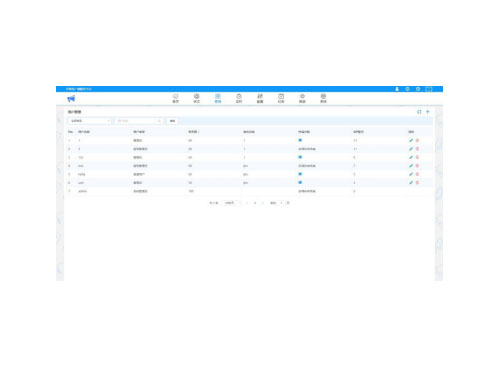
○The system supports multi-user, arbitrary-level distributed control management, enabling remote program playback management. It also supports multi-user, multi-level, specified permission, specified function, specified terminal-based categorized management of the backend.
○The system supports setting different lighting modes for the terminal, allowing users to customize the red light on/off, green/blue light on/off time (0-10 seconds). The system also supports configuring the terminal's time display, allowing users to set 1-6 brightness levels and configure the system to not display the time after network disconnection.
○The system supports timed ringing, ringing scheme cloning, task execution and stop control, and timed task disabling and enabling. The system supports simultaneous activation of multiple timed ringing schemes, with each scheme supporting multiple tasks running concurrently. All schemes can be enabled/disabled with a single click.
○The system supports programmable scheduled tasks, allowing for multiple scheduled scenarios, selection of any terminal, and setting of any time. It also supports scheduled task execution testing and setting repetition cycles. Multiple audio source options are supported for scheduled tasks (music playback, sound card capture, and terminal capture).
○The system is compatible with any network structure, including routers, switches, bridges, gateways, modems, Internet, 2G, 3G, and 4G.
○The broadcast system management and control software, installed in the network broadcast control center or computer, is a comprehensive management platform for data exchange, system operation, and functional operation of the broadcast system. The system software is the core of the entire system, uniformly managing all audio terminals within the system, including paging microphones, intercom
terminals, broadcast terminals, and fire alarm interface equipment, and displaying in real-time operating statuses such as IP address, online status, task status, and volume of the audio terminals.
○Windows service mode, supporting Windows 7, Server 2008 and later versions. The system runs as a background service, a standard enterprise-level server operating mode. It starts automatically upon system startup, offering higher stability and reliability compared to software running in the foreground. It supports customizable login screen backgrounds and restoration of the default login screen.
Software Functions
○The system supports terminal audio acquisition and playback, enabling the acquisition and playback of audio files for listening tests. It also supports remote control playback, allowing for remote playback from the playground. Furthermore, the system supports local audio acquisition, allowing playback to any designated terminal.
○The system supports terminal tamper-proof alarm functionality, where terminal removal triggers an alarm or other terminal linkage triggers an alarm; it also supports automatic alarm deactivation for alarm tasks. It supports full-area and zone-based fire alarm linkage, supports N±N fire alarm modes, and supports both manual and digital alarms. It supports configuring alarms to trigger terminal data collection tasks.
○The system supports terminal short-circuit input linkage triggering function, and the linkage triggering scheme and the number of triggering terminals can be set arbitrarily. The triggering schemes include short-circuit output, music playback, patrol alarm, etc.
○The system supports real-time monitoring of terminal online/offline status and usage status, and real-time management of terminal volume and current tasks; it also allows for custom terminal partitioning to manage terminal status by region, which is convenient and intuitive.
○The system supports management functions for temporary tasks, scheduled tasks, and scene invocation on the central control terminal.
○The system supports unified management of terminal login passwords, multi-level priority management, and easy automatic authorization. It supports 4x100 levels of customizable task priority configuration (server priority, task priority, user priority, terminal priority) to meet the automatic scheduling of tasks with various priorities.
○The system supports audio and text broadcasting, allowing terminals to simultaneously play sound and publish text information. It also supports LED display information publishing, digital and analog clock selection, and offers options for font size, font adjustment, display introduction, introduction, pause mode, and pause time.
○The system supports configuring specified terminals to enable exam mode within a specified time period. In exam mode, the digital and simulation backups can switch between each other, and the system supports one-click termination of exam mode for all devices. The system also supports configuring a terminal freeze time function, which prohibits the terminal from performing tasks during the freeze period, suitable for scenarios such as exams or breaks.
○The system supports categorized and user-specific management of media files, and can be configured with public/private folders, with private files used separately.
○The system supports offline timed ringing, enabling the terminal to host and execute timed ringing tasks when the network is disconnected; it also supports offline downloading of timed ringing tasks.
○The system supports viewing today's task list, making it easy to manage information and execution status of all scheduled tasks executed today.
○The system supports broadcasting, intercom, real-time data acquisition, and terminal monitoring for recording. It supports batch modification of scheduled
task times, volumes, and executing terminals. The system also supports custom terminal area division, enabling real-time zone-based management of terminal status.
○The system supports power control zoning settings for 8-channel power zoning terminals, which can be easily configured via a web-based backend or a separate control client. The system also supports 3- and 4-wire audio control with forced switching (4-wire audio control requires an external power supply).
○The system supports timed patrol functions, allowing users to customize the execution time and repetition cycle of patrol tasks. The indicator light flashing interval can be customized from 0 to 30 seconds. It also supports an external unlockable button short-circuit switch (with a 3.3V LED indicator).
○The system supports a scheduled interruption mode, automatically generating ringing tasks in batches without the need for individual editing, making it simple and easy;
Technical Specifications
○The system supports the function of exporting terminal details, which allows the configuration details of the current system terminals to be exported in a table format, bringing convenience to system management.
○The system supports external power management for audio terminals, including timed on and delayed off functions; it also supports lighting control and allows configuration of lighting modes.
○The system supports program library resource management, provides timed playback and real-time on-demand media services for all audio terminals, responds to program playback requests from each terminal, and provides data interface services for each audio workstation.
○The system supports multiple call strategy functions, including no-response transfer, busy line transfer, and power-off transfer, and supports custom settings for time-based and transfer strategies. It also supports setting call strategies for intercom terminals, allowing users to customize call durations from 0-180 seconds or without restrictions, choose whether to automatically answer calls, and customize incoming call ringtones and waiting ringtones.
○The system supports remote firmware upgrades for terminals, eliminating the need for local upgrades and reducing the workload of maintenance personnel.
○The system supports integration with high-precision GPS-based timing systems and can independently broadcast time synchronization without the Internet, ensuring that the system time error is less than 1/300,000 second per year.
○The system supports electronic map functionality, allowing users to view terminal status in real-time on the map/guide map. The system also supports online map functionality, enabling users to directly use Baidu Maps to view terminal status in real-time on the map.
○The system supports SIP broadcasting for zoned or area-wide broadcasting; it also supports a special mode for the National College Entrance Examination (NCEE) and an independent examination mode, and with the offline playback function, it can push preset examination content to the terminal's built-in storage, enabling local playback even when the network is offline.
○The system supports the operation of various audio terminals, is responsible for audio stream transmission management, responds to playback requests from various audio terminals and full-duplex audio switching, supports B/S architecture, and can perform terminal management, user management, program playback management, audio file management, recording storage, internal communication scheduling and processing and other functions through web login.
○The system provides full-duplex voice and data exchange functionality, responds to calls and call requests from various intercom terminals, and supports call modes such as one-click calling, one-click intercom, one-click help, and one-click alarm. It also supports automatic answering, manual answering, and customizable answer prompt tones.
○The system expands to support mobile WIFI on-demand, broadcast, and intercom
functions, and is compatible with Android and iOS mobile apps for operation.
○The system is extended to support telephone broadcasting, enabling telephone-initiated area-wide broadcasts, zone broadcasts, and intercom functionality.
○The network broadcasting system supports IPv6 and IPv4 network protocols and can realize terminal broadcasting, scheduled task playback, remote calling, and intercom functions based on IPv6 network.
○The system supports display screen task functions and LED display screen information publishing functions. It supports displaying server time (year, month, day, hour, minute, second).
○The system supports setting automatic hang-up for broadcast timeout and automatic hang-up for intercom timeout. The default value is 0, which does not limit the session time. After setting, the task will automatically end after the specified time.