General
- General
- Solutions
- Products
- Cases
- Technology
- News
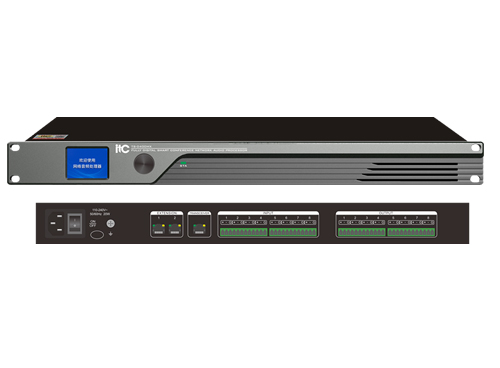
Employing a gigabit network audio transmission architecture and paired with a fully digital smart conference host, it supports audio inputs such as digital conference microphones and UHF microphones, and can flexibly conduct multi-room conferences, achieving 48kHz uncompressed audio transmission. It supports access to fully digital and Wi-Fi conference systems, features 8 multi-function outputs and multiple mode selections, and has built-in DSP independent adjustment; it can be cascaded to over 100 outputs.
* Employing independently developed clock synchronization and digital transmission technologies, it achieves uncompressed audio transmission at a sampling rate of 48kHz; possessing professional-grade audio processing capabilities, it achieves end-to-end processing latency as low as 2–3 milliseconds through segmented compression mixing technology and high-precision clock synchronization transmission technology, from conference unit sound pickup to audio processing output.
* It features highly integrated DSP audio processing capabilities, including ducking, automatic gain control, equalizer, compressor, expander, automatic mixing, feedback suppression, echo cancellation, ambient noise reduction, matrix routing, EQ adjustment (supporting 8-band, 10-band, 15-band, and 31-band EQ adjustment), volume dB adjustment, delay, limiter, and phase inversion.
* It can work seamlessly with the conference host to enable flexible expansion of microphone output interfaces; the system supports unified scheduling of wired and wireless conference hosts, and expands multiple output channels through cascading, making microphone audio management more scalable and ensuring system consistency.
* It features an 8-in, 8-out analog audio interface, supports audio matrix configuration, and allows for adjustable input sensitivity based on the audio source. All 8 input channels support 48V phantom power and can be individually configured to be enabled or disabled, offering flexibility and convenience.
* The output channels can be configured as wired character separation output mode, wireless character separation output mode, simultaneous transmission output mode, and phase control mode; each audio output channel can independently adjust audio parameters, including volume adjustment, equalizer adjustment, delay adjustment, limiter adjustment, and phase inversion adjustment functions.
* The role separation output mode allows wired or wireless units to output independently based on their ID numbers. By expanding the wired units, it supports 128 independent audio outputs, and the wireless units support 8 independent audio outputs. It also supports independent recording of each unit through recording software or docking with a speech-to-text device to achieve role separation.
* It supports 8-channel simultaneous output mode, with simultaneous audio output independently based on channel number, which can be used by recording or monitoring devices. Furthermore, the number of output channels can be cascaded with external audio processors.
* It is compatible with simultaneous connection of digital wired microphones, digital wireless microphones, and analog microphones, and all three can be used in parallel. It adopts cross-domain audio synchronization technology, provides input configuration functions, supports selection of any input channel, can switch between microphone input and line input, and adjust phase inversion, volume, duck, automatic gain, equalizer, compressor, and expander. In microphone input mode, it can also control the phantom power switch, configure camera tracking, voice tracking thresholds, and switch functions.
* It features automatic mixing capabilities, including gain-shared automatic mixing and gated automatic mixing; it has two mixing group settings, with mixing modes including gain-shared automatic mixing and gated automatic mixing. Gain-shared automatic mixing allows setting output gain, gain step size, slope, response time, and mute on/off audio parameters, including input source gain, mute, priority, and automatic mixing settings; gated automatic mixing allows setting output gain and mute on/off audio parameters, including input source gain, mute, sensitivity, and automatic mixing settings.
* It supports adjustable output channel equalizers, with each channel featuring a 12-band parametric equalizer or graphic equalizer, offering 10, 15, and 31-band graphic equalizers. The parametric equalizer supports selection of overhead, undermount, and parametric filter types, as well as setting parameters such as frequency, gain, and Q/OCT; the graphic equalizer supports three modes: narrowband, normal, and wideband.
* It features multiple input modes, including input mode, microphone mode, and simultaneous interpretation mode. Input mode uses local signals as regular matrix routing. Microphone mode virtualizes local inputs 1-8 as wired microphones and sends them directly to the conference host for management. Simultaneous interpretation mode virtualizes the corresponding inputs as interpreter channels, enabling direct audio transmission back to the host, thus significantly improving the system's adaptability to diverse changes in conference architecture.
* The EXTENSION 1 port features a network mode switching function and supports enabling recording mode. Once recording mode is enabled, the recording source can be flexibly selected via a PC client: independent recording can be performed on a single microphone unit, or all microphones can be recorded with a single click. The system supports up to 16 microphones recording simultaneously, with each microphone recording an independent audio track for easy post-processing. Recording files support WAV format, and the storage location of the recording file can be directly accessed after recording is complete.
* It supports device ID encoding and has an automatic duplicate ID detection mechanism; when multiple network audio processors are used simultaneously, it can automatically identify ID conflicts and provide prompts, ensuring the standardization of system topology numbering and the stability of system operation.
* It features a 2.0-inch LCD display and a rotary encoder, supports switching input channel modes, including input mode, simultaneous interpretation mode, and microphone mode; font switching, including five fonts: Simplified Chinese, Traditional Chinese, English, Russian, and French; and displays local information, including IP address, device IP, and device version number.
* It has a screen lock function. After the screen has been idle for a period of time, it will automatically enter standby mode and can be unlocked by pressing and holding the knob encoder.
|
Frequency response |
±1dB 20Hz~20KHz |
|
Signal-to-noise ratio (maximum) |
18 dBu, ≥110 dB (A-weighted) |
|
Total Harmonic Distortion |
4dBu≤0.002%@1KHz |
|
Audio input interface |
LINE IN: 8-channel balanced input (Phoenix terminal) |
|
Audio output interface |
LINE OUT: 8-channel balanced output (Phoenix terminal) |
|
EXTENSION port |
2-way (10/100/1000Mbps), connecting to a gigabit conferencing host. |
|
TRANSEIVER network port |
1 line (10/100/1000Mbps), connecting to the wireless AP |
|
Pulse code potentiometer |
Select Edit menu |
|
Static power consumption |
7W |
|
Power input range |
110-240V AC |
|
Display screen |
2.0-inch TFT LCD screen |
|
Color |
black |
|
Net weight |
2.4kg |
|
External dimensions (L×W×H) |
484mm×261mm×52mm |
|
Installation method |
Rack-mount installation |
Please leave a message if necessary, we will contact you as soon as possible!